
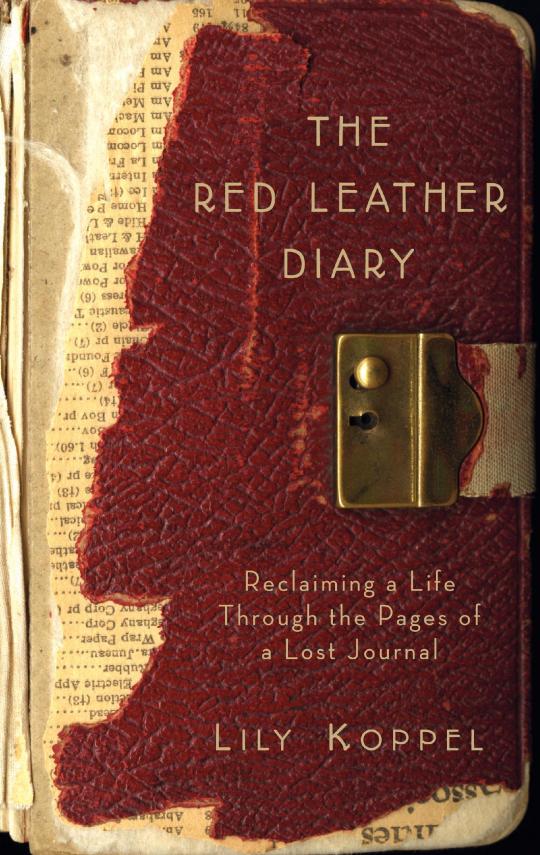
EXCERPT: Red Leather Diary by Lily Koppel
Monday, April 14th, 2008
 Painted—played piano—read Baudelaire—and saw Manny. But I couldn’t resist thinking about that girl—! Invited that girl—Pearl is her name—to tea next Thursday afternoon—I hope I’m not disappointed—with her voice, I shouldn’t be.
According to plan, Florence and Pearl Siegelstein met, one late afternoon in March 1932, at an English tearoom on Lexington Avenue, advertised as “a rendezvous for Hunterites.” Italian mosaic tiles fanned out over the floor. Red leather banquettes promised privacy, cordoned off by frosted glass beneath art nouveau chandeliers. It was Prohibition. Even the most innocent teashop had an air of mystery. A violinist played Haydn. Florence had first been invited to the genteel tearoom by her mathematics professor from last year, also a lover of classical music. Attractive, lonely Dr. Marguerite D. Darkow, much admired by her students, had noticed her young pupil, so worldly and wise for her sixteen years. Visited a former teacher of mine, Dr. Darkow, and was amazed by her pessimism and dependence. She is brilliant.
Florence began visiting Dr. Darkow at her teacher’s small Yorkville apartment, where they drank more tea, smoked cigarettes, and listened to the phonograph play sonatas, partitas, and fugues. Dr. Darkow told about her years at Bryn Mawr and graduate studies at the University of Chicago. Florence revealed how she longed to travel abroad. Dr. Darkow pointed out that Europe was ripping apart at the seams. To Dr. Darkow tonight and talked hours on the economic condition of the world—she expects general massacre within 5 years—it is possible. Florence also became friends with her young German instructor, Fraulein Hildegarde Kolbe.
Tea with a beautiful and gracious lady and decided to become sweet and charming—It’s an easy way to embarrass people. Miss Kolbe had come to the States after the war to go to Smith, where Florence had wanted to transfer, but the Wolfsons vetoed her plans to attend the social work program because it began in the summer. “The summer is when you go to the mountains to meet men,” said Mother.
A more gratifying time than I have experienced in a long while—Pearl fascinates me! We sipped delicious coffee and exquisite apricot brandy.
Now, Florence shared a booth with Pearl, whose auburn hair was pinned back from her rather pretty face. Pearl looked intently at Florence over her china cup, stirring in a few sugar cubes. She managed to combine feminine charm with strength of character and good nature. Florence was sixteen. Pearl was nineteen, a senior. Both young women wrote for Echo, Hunter’s literary magazine. Pearl was a playwright with three original plays under her belt and had been one of ten elected to the honorary English society. Her last name, Siegelstein, meant “one who pushes rocks.” Florence thought it an apt description for this intelligent brunette with heart-of-stone determination. Her first name was also fitting. Pearl usually had le mot juste.
Pearl’s parents, immigrants from Eastern Europe, were descended
from stonemasons in the Carpathian Mountains. Pearl had grown up in Harlem, and Florence’s brownstone memories resonated with her. She had also attended Wadleigh, although the two hadn’t known each other there. Her family’s relocation to the Bronx was a source of great distress. Pearl felt as if she had been banished to Siberia. Her family thought that her father, a truck mechanic, was crazy to let her go to college. She could have been working, contributing something to the family pot. After all, it was the Depression. But her father said that if Pearl wanted to go to college, she should go. Pearl was tremendously likable, and Florence was strongly attracted to her.
Was rather cold to Pearl in class today and feel like a little beast—I’ll ask her to lunch on Thursday—I could almost love her!
Arm-in-arm, the young women walked New York, experiencing the city through each other’s eyes, talking over ideas for plays. Florence had just finished reading The Monk and the Dancer by Arthur C. Smith, and was looking forward to his second short story collection, The Turquoise Cup. They passed the usual corner scene of down-and-out former Wall Street brokers selling apples and pencils from cardboard boxes. Florence was used to looking away as she tossed in a coin, but Pearl opened her eyes. They were just trying to feed their families. She insisted Florence look at them.
Out with Pearl tonight and accidentally came upon a life that was real and beautiful and made me feel loathsome—a blind pianist who is happy—in a small cheap restaurant.
They spent hours in Central Park. They admired Cleopatra’s Needle with its twin in London and a similar obelisk at the Place de la Concorde in Paris, uniting them in their love of antiquity and European culture. They lingered at the Shakespeare Garden, planted only with flowers that appeared in the Bard’s sonnets and plays. They passed the Hooverville of shacks in the old emptied reservoir north of Belvedere Castle. Slim lines of smoke rose from the fragile makeshift structures and tents.
Pearl now completely dominates my mind—Once I hop over my stone wall, I’m lost—but something about her gets me!
On a park bench, Florence and Pearl discovered they shared a love of Alice in Wonderland, reciting in unison, “Jam to-morrow and jam yesterday—but never jam to-day,” and John Webster’s poem “Nets to Catch the Wind”: “Vain the ambition of kings who seek by trophies and dead things to leave a living name behind, and weave but nets to catch the wind.” They didn’t leave the park until the lamps glowed in orange-pink orbs at twilight. Not long ago these were gas lamps lit by hand. Much had changed since their parents arrived in America. The flappers had shed corsets and the stiff old Victorian designs for free-flowing materials, altering the
way they moved through the world. Zippers had replaced troublesome buttons and hooks and eyes. Everything was speeding up. Old rules were there to be broken. The Depression wasn’t going to stop them. They were going forward. The hell with men.
Buy the book here. Read an interview with Lily Koppel here.





http://www.videopornotribe.com Thanks for that awesome posting. It saved MUCH time
I know this if off topic but I’m looking into starting my own weblog and was curious what all is needed to get set up?
I’m assuming having a blog like yours would cost a pretty
penny? I’m not very web savvy so I’m not 100% certain.
Any suggestions or advice would be greatly appreciated.
Appreciate it
ddfdnbzfgje1yisv2xxcdfe2chkzcschkwcaxvbne2bhyuzv1chyuzcdnbwe
What’s up to all, since I am in fact eager of
reading this web site’s post to be updated regularly.
It carries good information.
At this time it seems like BlogEngine is the top blogging platform out there right now. (from what I’ve read) Is that what you’re using on your blog?
Mane quickly followed up with Liverpools fifth before Daryl Janmaat pulled one back for the struggling visitors.
Whoever we end up with I hope they are much more successful than our summer signings.
I recommend you to check https://justbuyessay.com/blog/academic-writing-solution-for-everyone out if you want to get Academic writing solution for everyone. I had such experience, by the way
thanks, Lily, great post. By the way, u can visit this service for writing https://do-my-assignment.com/buy-essay-australia where I always order essays. Trust me, he is one of the best ever!
Thanks, this post is valuable for me. Guys, do u know is this writing service https://www.assignmentjunkie.co.uk/write-my-assignment-for-me/ good enough to write assignments? Cause my friend recommended it for me, but I wanna check it somewhere else.
Thanks for the blog loaded with so many information. I’ll be sure to bookmark it and, come back to read more of your useful info. https://www.travelcarma.com/travel-agency-software.htm
I do consider all of the concepts you’ve introduced in your post. They are very convincing and will certainly work. Still, the posts are very quick for newbies. May just you please prolong them a little from next time? Thank you for the post.
This is a very good tip especially to those new to the blogosphere. Brief but very precise info… Many thanks for sharing this one. A must read article!
Hello.This post was extremely fascinating, especially because I was investigating for thoughts on this matter last Wednesday.
Red Leather Diary? It sounds shady guys. By the way, you can find here a lot of writing services reviews https://topeduservices.com/reviews/paperhelp-org/ especially paperhelp review can be found there. I think that can be useful for students.
I’m looking all over google, trying to figure out what the song is in this trailer! It’s driving me mad!https://www.lawessayservices.co.uk/
I’m looking all over google, trying to figure out what the song is in this trailer! It’s driving me mad! https://www.lawessayservices.co.uk/
Very interesting book. I like to read when I have free time. By the way, you can check a blog of a mobile app development company at https://madappgang.com/blog/how-to-develop-a-medicine-delivery-app to read about medicine delivery applications development. I’m sure that it would be useful to read.
Hi guys. Great thread. Thank you. Is there anything else similar?
Florence began visiting Dr. Darkow at her teacher’s small Yorkville apartment, where they drank more tea, smoked cigarettes, and listened to the phonograph play sonatas, partitas, and fugues. Dr. Darkow told about her years at Bryn Mawr and graduate studies at the University of Chicago. Florence revealed how she longed to travel abroad. Dr. Darkow pointed out that Europe was ripping apart at the seams. To Dr. Darkow tonight and talked hours on the economic condition of the world—she expects general massacre within 5 years—it is possible. Florence also became friends with her young German instructor, Fraulein Hildegarde Kolbe.
I do consider all of the concepts you’ve introduced in your post. They are very convincing and will certainly work. Still, the posts are very quick for newbies. May just you please prolong them a little from next time? Thank you for the post.
The time has come for you to pick the right laundry app development software and make your customer’s laundry problems vanish. We are an expert in on-demand laundry application development services all around the globe for iPhone and Android platforms.
https://lilacinfotech.com/what-we-do/laundry-on-demand-app-development-india
Thanks for sharing, you can try quickshortcutmaker android app to fix shortcuts on your phone. I believe you will like it.
Exactly! writing an assignment is a very difficult task of You’re now confronted with past due-to-submission consequences and a loss of motivation to start the project. Why now no longer order the first-class law essay writing services in preference to happening consequences? Students will now no longer most effectively get hold of great content, however, they’ll additionally have the choice of hiring a subject-depend expert. Students can use their unfastened time to recharge and attention to different initiatives with the aid of using delegating tough essays to a person else.
When read your blog on the red leather diary its consist on the many helpful keywords those are helpful for me because i’m also a writer mostly working on the engineering thesis help writing services to the students.
Wow Great post thanks a lot
car booking api
Thankful for sharing information that is actually helpful. Good day!
click here
good
The majority of students use this diary to take notes so they may write their law dissertations writing flawlessly.
Thanks for the blog loaded with so much information. I love this post
Thanks, what you shared is great.
Thanks, please refer to the darmowe dzwonki na telefon bez rejestracji that I like the most.
Hello Dear, I read this article. I hope you will keep providing such posts for everyone to read! thank you.
Hello Dear, I really loved reading your blog. It was very well tailored and easy to understand. Unlike other blogs I have read, which are really not that Great. thanks
My name is Daniel Ethan and I work as a Digital Marketing Executive at Travelolog LLC. I am passionate about utilizing digital platforms to create effective marketing strategies and drive business growth. I am constantly learning and adapting to the ever-changing digital landscape to deliver outstanding results.
We collaborate with educational institutions to develop tailored solutions that address their specific needs and challenges. Our services include program evaluation, accreditation support, and institutional assessment to help institutions maintain high standards of academic excellence.
Welcome to cheap blog writing services, we collaborate with educational institutions to develop tailored solutions that address their specific needs and challenges. Our services include program evaluation, accreditation support, and institutional assessment to help institutions maintain high standards of academic excellence.